
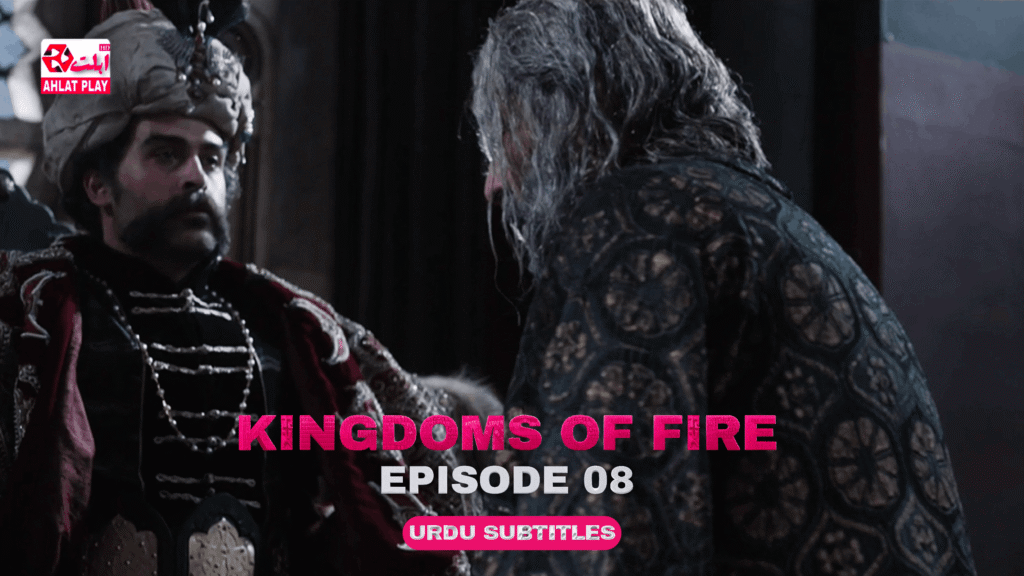

Kingdoms of Fire Episode 8 – Sultan Selim Turns His Attention Toward Egypt
Kingdoms of Fire Episode 8 marks the beginning of a historic transformation in the Middle East as Sultan Selim I shifts his attention from internal Ottoman affairs to the powerful Mamluk Sultanate. After securing the Ottoman throne and restoring stability within the empire, Selim begins preparing for campaigns that will reshape the political map of the Islamic world. The episode follows historical developments and lays the foundation for the coming Ottoman-Mamluk War.
To watch next Episodes Join Paid Group:


OR Scan The QR code to Join!
Sultan Selim Consolidates His Rule
Following his accession to the throne, Kingdoms of Fire Episode 8 shows Sultan Selim focusing on strengthening the Ottoman administration. He appoints trusted governors, reorganizes the imperial army, and ensures that every province remains loyal to the central government.
Selim understands that no great military campaign can succeed without internal stability. His first priority is to eliminate political uncertainty and establish a disciplined government capable of supporting future conquests.
His leadership quickly earns the respect of military commanders and state officials.
The Eastern Frontier Becomes a Priority
After securing the empire, Sultan Selim begins examining developments along the eastern frontier. Reports from his advisors describe growing instability caused by regional rivalries and changing alliances.
Historically, Selim first dealt with eastern threats before turning his attention toward the Mamluks. The episode highlights his strategic thinking as he works to secure the empire’s borders and protect important trade routes connecting Anatolia, Syria, and Egypt.
Every decision is made with long-term imperial expansion in mind.
Egypt Emerges as the Next Strategic Objective
One of the most significant developments in Kingdoms of Fire Episode 8 is the growing importance of Egypt in Ottoman strategy. The Mamluk Sultanate controls wealthy cities, major trade routes, and the holy cities of Makkah and Madinah through its sphere of influence.
Selim realizes that control over these regions would greatly strengthen the Ottoman Empire both politically and economically. Discussions within the Imperial Council reveal that Egypt is becoming increasingly important in Ottoman foreign policy.
Although war has not yet begun, preparations slowly move in that direction.
Tuman Bay Strengthens the Mamluk Sultanate
Meanwhile, the series shifts to Egypt, where Tuman Bay continues proving himself as one of the Mamluk Sultanate’s most capable leaders. He works to improve military readiness, strengthen border defenses, and maintain unity among the Mamluk emirs.
Tuman understands that the political climate is changing rapidly. Reports from neighboring regions suggest that the Ottoman Empire is becoming stronger under Sultan Selim’s leadership.
Despite growing concerns, Tuman remains determined to defend the independence and honor of the Mamluk state.
Diplomacy Gives Way to Suspicion-Kingdoms of Fire Episode 8
Throughout Kingdoms of Fire, diplomatic relations between the Ottomans and the Mamluks become increasingly fragile. Envoys exchange messages, but trust continues to decline as both powers question each other’s intentions.
Military commanders on both sides begin preparing for the possibility that diplomacy may eventually fail. The atmosphere of uncertainty creates tension throughout the episode, even though open warfare has not yet begun.
These developments accurately reflect the growing rivalry between the two great Muslim empires during the early sixteenth century.
Preparing the Ottoman Army-Kingdoms of Fire Episode 8
Another major focus of Kingdoms of Fire is the preparation of the Ottoman military. Sultan Selim orders inspections of the Janissaries, cavalry units, artillery, and logistics.
The army undergoes extensive organization to ensure it is ready for long-distance campaigns. Supplies, weapons, and communication networks are carefully planned before any military movement begins.
These preparations demonstrate why the Ottoman military was regarded as one of the most disciplined fighting forces of its time.
Egypt Prepares for an Uncertain Future
Inside Cairo, concern grows among the Mamluk leadership. Although daily governance continues, many commanders fear that confrontation with the Ottoman Empire is becoming unavoidable.
Tuman encourages unity among the Mamluk nobles, reminding them that internal divisions could prove more dangerous than any external enemy. His speeches inspire confidence, but political disagreements remain a constant challenge.
The episode successfully portrays Egypt as a powerful state preparing for one of the greatest tests in its history.
The Road to a Historic Conflict
By the conclusion of Kingdoms of Fire Episode 8, both empires stand on the edge of a historic confrontation. Sultan Selim has secured his throne, strengthened his army, and begun looking toward Egypt as the next objective of Ottoman expansion.
At the same time, Tuman Bay continues strengthening the Mamluk Sultanate, fully aware that the future of Egypt may soon be decided on the battlefield.
Conclusion
Kingdoms of Fire Episode 8 serves as an important bridge between the Ottoman succession story and the coming Ottoman-Mamluk War. Following historical events, the episode shows Sultan Selim consolidating his authority, preparing his army, and gradually directing Ottoman strategy toward Egypt.
Meanwhile, Tuman Bay works tirelessly to protect the Mamluk Sultanate from the growing Ottoman threat. With diplomacy weakening and military preparations accelerating, the episode sets the stage for one of the most significant conflicts in Islamic history, where two great empires will soon battle for control of the Middle East.